
Claude is the model we evaluate for the majority of production AI work we ship: retrieval over private data, agent workflows inside operational tooling, document understanding for regulated industries, and the AI surfaces that sit inside customer-facing products. We choose Claude when its capability and safety profile fit the work, and we say so when a different model fits better.
Building with Claude.
Claude Partner Network member. Three years of production AI work with Claude, across energy, media, financial services, legal tech and healthcare.
Three ways Claude shows up in our work
First, in the AI we build for clients.
Second, in how we deliver.
Claude Code is part of how our engineers work day to day, and the AI-augmented delivery model we sell to clients is the same one our own teams use. We don't sell AI delivery practices we haven't lived with ourselves.
Third, in how we replace older AI.
Clients who built bespoke ML models for classification, forecasting, or extraction are evaluating where an LLM API does the same job with lower maintenance overhead. We guide those decisions and implement the replacements alongside the client.
Where Claude fits, and where it doesn't

Claude is the right answer for a wide class of production AI work, particularly where reasoning quality, instruction following, and safety properties matter. It's the model we reach for first, and not the model we reach for every time.
There are workloads where a smaller, cheaper model is the right answer. There are workloads where an open-weights model running in the client's own infrastructure is the right answer. There are workloads where a non-LLM approach is the right answer. Calling that early in an engagement is part of the value, and it's a conversation we'd rather have at the start than after a build.
We evaluate models on merit per use case. Three years of comparative experience across production systems means we have a view, not just a preference.
There are workloads where a smaller, cheaper model is the right answer. There are workloads where an open-weights model running in the client's own infrastructure is the right answer. There are workloads where a non-LLM approach is the right answer. Calling that early in an engagement is part of the value, and it's a conversation we'd rather have at the start than after a build.
We evaluate models on merit per use case. Three years of comparative experience across production systems means we have a view, not just a preference.
Inside the Claude Partner Network
We're a Claude Partner Network member. Our engineers have completed Anthropic's full learning path, covering agent skills, the Claude API, Model Context Protocol, and Claude Code. We participate in early-access programmes and feed back to Anthropic on what's working and what isn't in production engagements.
Our Work
Web3
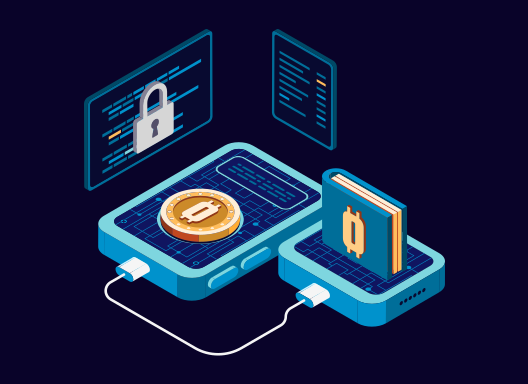
Scaling security and reliability with DevOps maturity
YLD delivered strategic recommendations to enhance security and reliability at scale that would enable faster innovation and better risk management.
Learn More

Research
Accelerating scientific progress through digital innovation
ASAP and YLD created a secure digital platform for collaborative research, establishing a technical benchmark and agile workflow to support the scientific community.
Learn More

Keep Reading
Governance
AI-Augmented Delivery
How we use Claude internally to deliver client work faster.
Learn More

Governance
AI-Shaped Services
Helping clients build AI into their own products and operations.
Learn More
Partnerships
AWS
Where most of our Claude-powered AI infrastructure runs.
Learn More

Building with Claude, or working out whether to?
We’ll tell you what works in production, not just in demos.