
Championed by YLD, Design Systems London (DSL) brings together product and engineering experts to discuss the latest in Design Systems.
On 16 September, the DSL community got together once again, this time at Revolut's office with a beautiful view over London.
We had yet another set of engaging and informative talks by three very impressive speakers: Tadej Razboršek, Lead Platform Engineer of Revolut, Aobakwe Anti, Design System Engineer who previously worked for Condé Nast, and Luke Murphy, Principal Design Advocate of zeroheight.
The event was, as per usual, hosted by Luis Klefsjö, Head of Product Design at YLD, but with the Q&A segment this time led by James Blakey-Hevey, Senior Product Designer and Design Systems expert at YLD.
If you couldn't make it, dive into the recap of the evening.
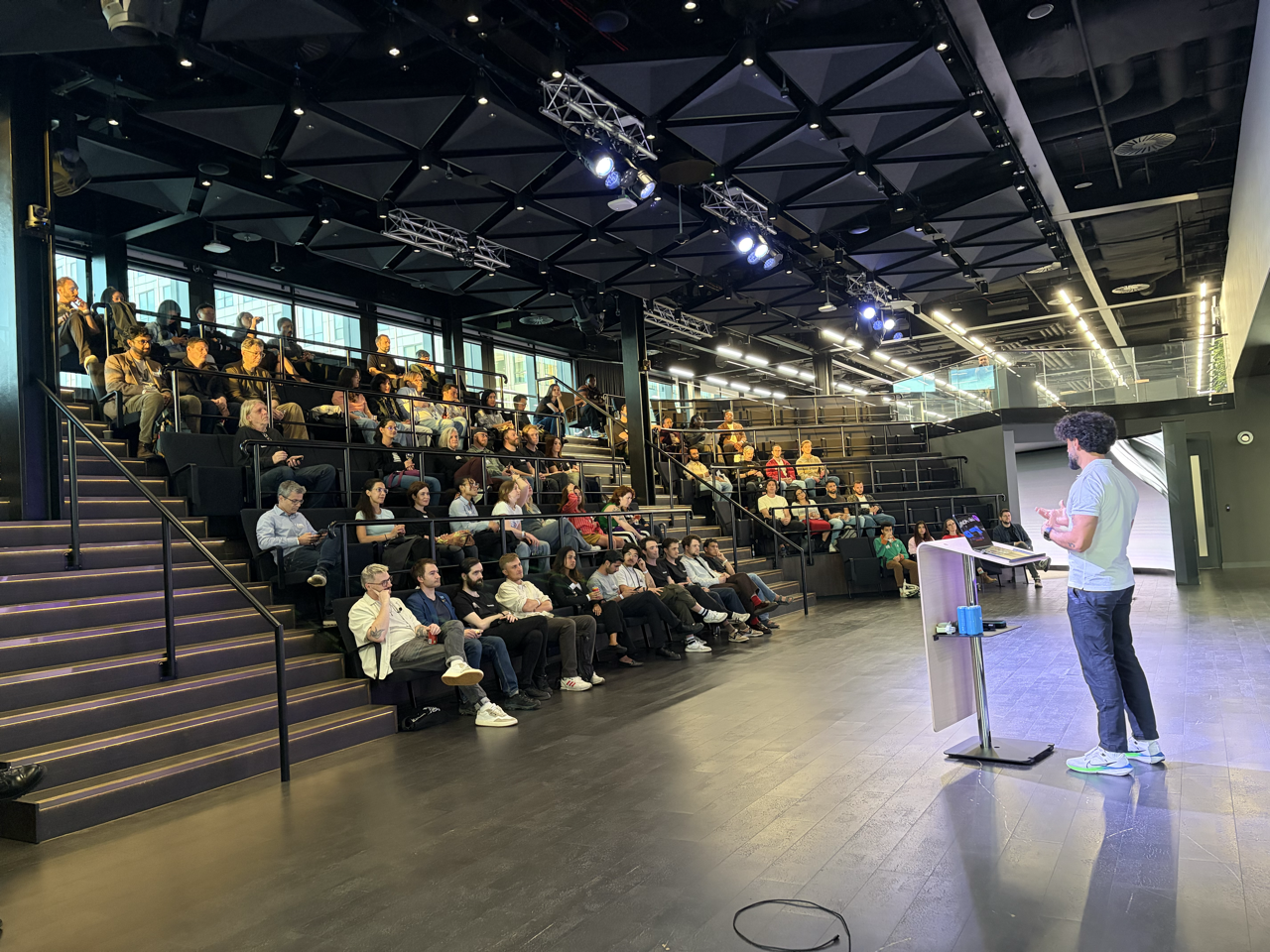
The talks
'100% Design System adoption. Dream, cost, and reality? by ’Tadej Razboršek, Lead Platform Engineer - Revolut
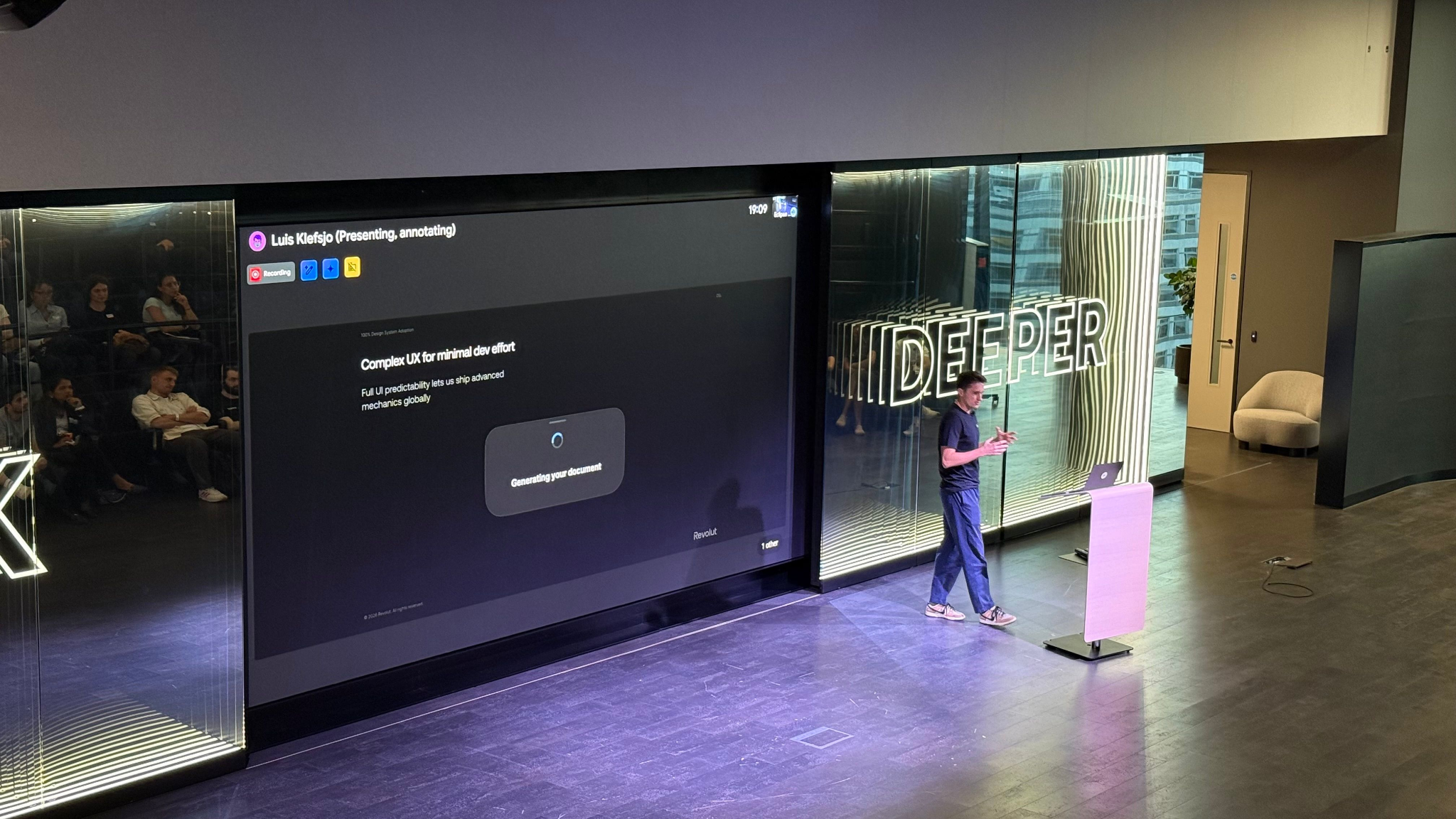
Tadej opened with his experience of achieving 100% design system adoption at Revolut, across a system that sees roughly 150 repository contributions a day and over 12,000 in the last 90 days, a figure that puts the scale of the challenge into perspective.
Achieving this required strict governance: every component on screen must come from the design system, Figma is the single source of truth, and there is a clear, enforced path from proposal to release. That rigour delivers real consistency, built-in accessibility, and the ability to roll out brand-wide changes without every team redoing the work. The trade-offs are real too, speed takes a hit in the short term, the design system team can become a bottleneck, and strict component enforcement does not fully resolve cross-team UX drift on its own.
Tadej walked through the mitigations his team has put in place and closed with practical advice for teams starting out: lay the foundations early, build for reuse from day one, and let governance grow as you scale. What works now should always be revisited as the system and the organisation evolve.
'Workflows at Scale: Design Systems, Platform Engineering, and the AI Workflows that scale’ by Aobakwe Anti, Design System Engineer
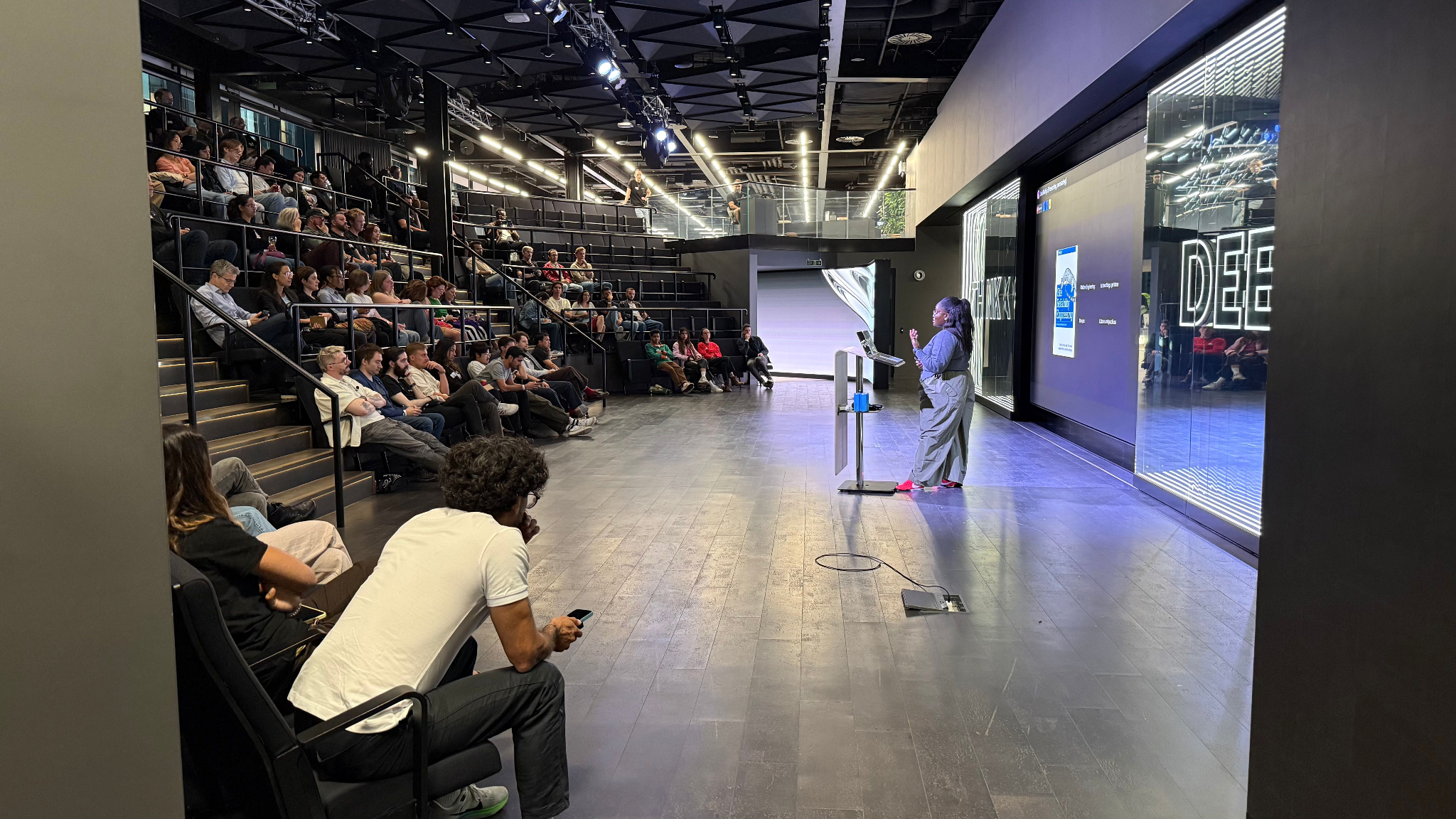
Aobakwe challenged the standard approach of treating a design system as a separate product, arguing the model works for a handful of teams but breaks down at scale, because a product solves one user problem, not the infrastructure an entire organisation needs. The seven-year-old system she worked with at a previous project showed the pattern: hard-coded tokens scattered through the codebase, two systems running in parallel, and understanding that varied wildly across the company. Upskilling built confidence, but didn't fix the underlying problem.
Her proposed fix is to treat a Design System as infrastructure, the same way a CI/CD pipeline is infrastructure, measured on how it scales rather than how it looks.
Two examples showed what was at stake. One was an untested change that briefly broke a major brand's site before being rolled back with no data lost. The other was a right-to-left localisation feature, built once into the infrastructure, that went on to enable an estimated $16M market launch.
This is what the talk was really building towards: what happens once AI enters the workflow. A strong, well-governed system can absorb AI safely and multiply its value, while a weak one gets its flaws amplified and exposed at scale, since every designer and engineer now works alongside an agent that can generate off-system without asking. Aobakwe set out three requirements for AI readiness: context (briefing agents with tokens and guidelines, not just prompting them), guardrails that enable rather than gatekeep, and monitoring built around drift detection. Her closing point was to get the system right first, and the AI benefits follow.
‘Design Systems are Dead. Long Live Design Systems’ by Luke Murphy, Principal Design Advocate - zeroheight
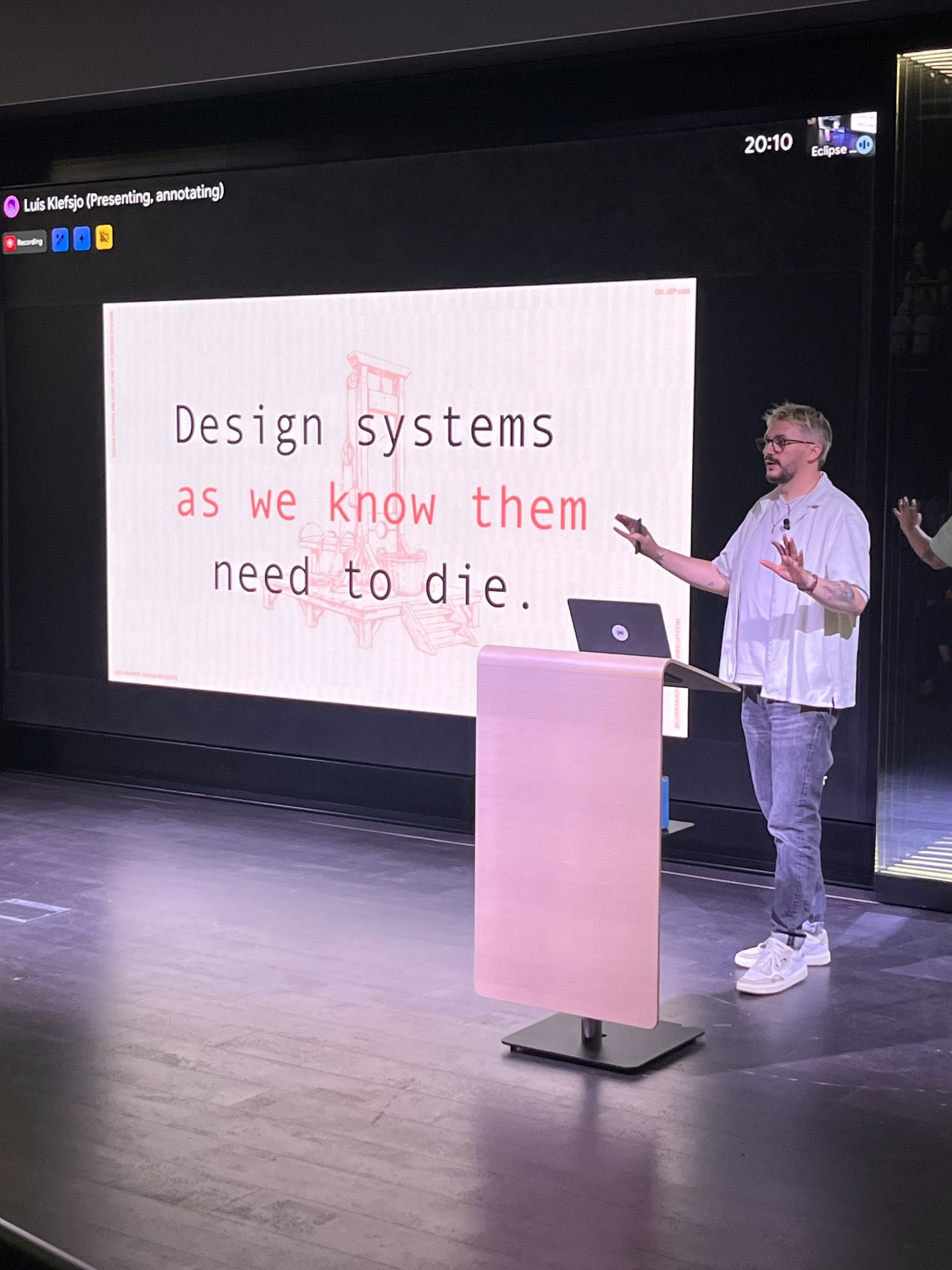
Luke opened with a deliberately provocative case that Design Systems must die, which probably had many in the room questioning DSL’s choice of speaker!
They, however, swiftly moved on to reassure us that what they meant is that the way most orgs currently run Design Systems must change, which had the audience settle down again. The argument was against the version of the work that turned into a commodified, capital-D-capital-S discipline with its own jargon and its own conference circuit.
Luke traced the discipline's short history. Pattern libraries date to the mid to late 2000s, but Design Systems only became a funded priority in the last decade, making the field barely ten years old. Gartner put it near peak hype around 2023. It's since fallen into the trough of disillusionment, with layoffs, deprioritised teams and stalled adoption to show for it.
Luke argues the root cause is self-inflicted. Teams built up a specialist vocabulary of their own, and that vocabulary made their value illegible to the two groups who actually matter, the people using the system and the people paying for it. Buy-in comes down to positioning more than it does to quality, and Design System teams positioned the work as a niche specialism rather than as infrastructure.
AI sharpens the problem too, as agents write and edit more code. A system that only lives in someone's head is invisible to that tooling. Machine-readable documentation and clearly defined contracts are where the real, defensible value sits now, since components themselves are trivial to spin up.
Luke's fix treats Design Systems as infrastructure, not a specialism that needs defending. That means borrowing the language platform and DevOps teams already use (platform, operations, enablement), measuring impact in terms leadership already tracks (time saved, defects avoided), and moving teams out of isolated "centres of excellence" into a hybrid model embedded within the product, the same way no one carves out a separate team to defend the existence of CI/CD.
Q&A
%20Large.png)
YLD’s Senior Product Designer and Design Systems expert James took the stage and carried the conversation further with our three speakers for the panel Q&A discussion, taking in questions from the audience.
The conversation ranged widely, but AI's role in Design Systems emerged as a recurring thread, surfacing across questions on tooling, governance, contribution, and the future of the discipline itself.
On tooling, the panel questioned whether Figma remains the right source of truth as AI becomes more embedded in the process, do we even still use Figma? The broad agreement was that permanent attachment to any single tool is unwise; ten years ago the industry was on Sketch. What matters is structuring the system in a way that can survive whatever comes next, and in the context of AI, that means ensuring machine readability.
On the human side, the consensus was more nuanced. AI shifts where the effort sits rather than eliminating it. As it absorbs more of the build work, the irreplaceable human contribution comes into sharper focus: taste, judgement, and the political and organisational complexity that Design Systems inevitably provoke. Contribution remains a deeply human process, one that requires diplomacy and nuance no model can replicate. That work is likely to matter more, not less, as AI continues to advance.
Community
%20Large.png)
These events would be nothing without the continuous support of our DSL community, and it was such a joy for us to welcome new members as well as seasoned visitors. We were extra excited to realise that many familiar faces have been with us since our initial conferences all the way through our online events until our in person evenings today!
We would like to also of course acknowledge and thank our speakers, and our sponsors! It was great working with the Revolut team and the event team at YLD who collaborated to put together such a great event.
You can watch the full recording of our DSL #17 here.
Keep an eye out for more event announcements on the DSL LinkedIn page.
See you at the next event!


.png)