
Recently I gave a webinar for the London Chamber of Commerce on Design Thinking in the age of AI. If you want to watch the full recording, the link is at the bottom of this article, but if you'd rather read the argument first, this is it.
Most organisations aren't short of ideas. What they're short of is the combination of thinking and judgment that turns those ideas into things that actually work, for real people, and for the business.
That gap is what Design Thinking is meant to close, and it does, when it is practised well. However, there is a version of the AI conversation happening right now that I think is getting in the way; the version that says AI is a superpower for Design Thinking, that it makes everything faster and easier, and that all you need is the right tools.
That version isn't entirely wrong. AI does make a lot of things faster, but it's the less interesting and less honest story. Here is what I think is more true: AI has made answers cheap. This means that in Design Thinking, the true human art is no longer knowing the solution, but discovering the right question to ask in the first place.
What Design Thinking actually is
Before getting into what AI changes, it is worth being clear on what Design Thinking is, because it is one of the most misunderstood frameworks in business.
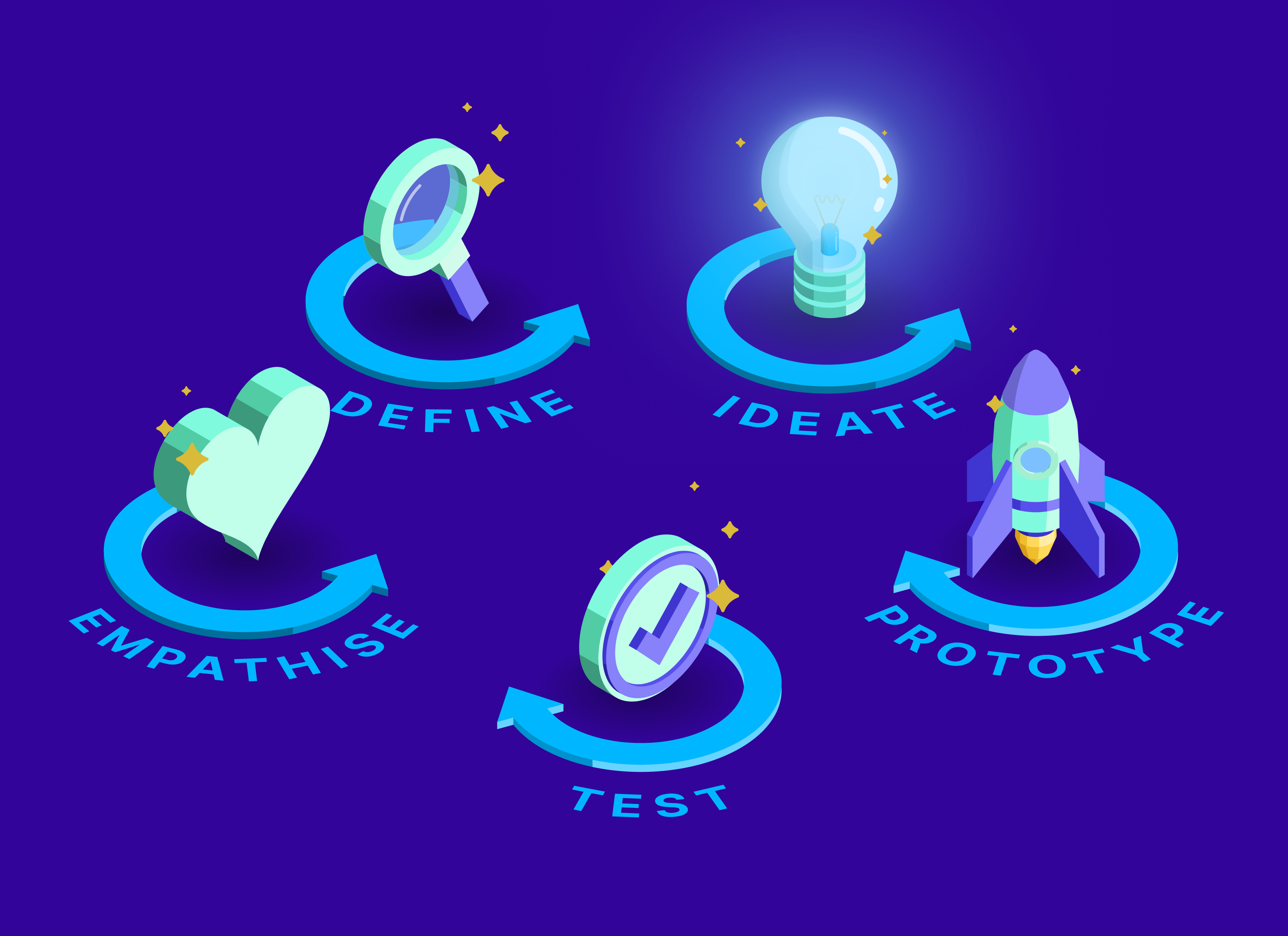
It isn't about making things look good. It's a structured way of making sure you're solving the right problem before you invest time, money and people into a solution. At its core: understand the people you're designing for, define the real problem clearly, ideate and generate a range of possible solutions, prototype something rough and cheap, and test it with real people. Then learn, and go again.
The reason this matters for business is straightforward. Consistently, across the organisations we work with, the same pattern appears. Projects that go over budget or miss the mark rarely fail because of poor execution. They fail because the team was building the wrong thing, and nobody caught it early enough. Design Thinking is the framework that catches it early.
The three assumptions AI is challenging
Design Thinking was built around human constraints. Research is slow, so we taught people to be deliberate and selective about it. Prototyping is expensive, so we pushed it downstream until we were confident enough to invest. Iteration is limited by team size, so we built processes to make every cycle count.
Those constraints shaped the practices. AI removes or radically changes several of them, which means some of those practices need rethinking, not discarding, just rethinking.
Empathy work is slow and human. That's the old assumption. AI can now synthesise large volumes of research significantly faster than any team could manually. What used to take weeks of affinity mapping can be done in an afternoon. In the discovery phases we run with clients, synthesising stakeholder interviews across an organisation into a coherent picture of what to prioritise has always been a “big job”. AI compresses that work substantially, but the synthesis was never really the hard part. The hard part is knowing what to do with it: which pattern is the signal and which is the noise? Whose perspective deserves more weight, and why? Those are judgment calls, and AI cannot make them for you. What it does is free you up to spend more time on the part that actually requires human judgment, which, if you're doing it right, is most of it. The designer's role in this situation is shifting from data retrieval to deeper, more focused inquiry.
Prototyping is a late-stage activity. That assumption made sense when making something testable was expensive and slow. A prototype that took weeks to build had better follow a lot of rigour. Now, when a designer can generate multiple concept directions in an afternoon, the logic changes entirely. You no longer need to wait until you're confident before you prototype. You can prototype to get confident. You can test three directions instead of one. The question shifts from "can we afford to build this?" to "which of these directions is actually worth pursuing?" That is a fundamentally better question to be asking earlier in the process.
Iteration is bounded by team capacity. A well-structured small team working with AI effectively can now achieve a level of output that previously required a much larger team. The bottleneck is no longer primarily capacity. It's judgment, which, as I tell the teams we work with, is genuinely good news; judgment is something your team already has.
AI scales execution, not strategic clarity
This is the part of the conversation that I think matters most, and that most people are not having.
AI doesn't solve a poorly defined problem. It accelerates execution of whatever premise you feed it. This means that if your team skips the foundational work of Design Thinking, AI doesn't save you; it just helps you produce the wrong thing faster, and at a greater scale. Aligned teams with a clear understanding of the problem become exceptional. Disconnected teams with a flawed premise become faster at building the wrong thing.
This is not an argument against AI. It's an argument for using Design Thinking as the framing that ensures AI is pointed at the right problems, with the right questions, at the right stage. Without that framing, you're not transforming your process, you are automating mediocrity.
Where to start
The right entry point depends on where your organisation is right now.
If you have no design process at all, start with a structured discovery before your next project kicks off. Talk to the people affected by what you're building before you commit to building it.
If you have design but it's disconnected from engineering or strategy, the lever to pull is proximity, not headcount. Get designers, engineers and product people working on the same problem at the same time.
If you have a process but aren't learning fast enough, move validation earlier. Test concepts before they become requirements, and use AI to compress your research synthesis so your team can spend more time on the judgment calls that actually shape direction.
Five things you can do this week
None of these require budget, sign-off, or a new tool. They just require someone deciding to start.
Run a problem framing session. Before your next project kicks off, get the key people in a room for 60 minutes and ask two questions: what problem are we actually solving, and for whom? Write the answers down and see if everyone agrees. You will be surprised how often they don't. Most projects that go wrong skip this conversation.
Talk to three users or customers. Not a survey, not a focus group. Three conversations, 30 to 45 minutes each, where you ask people about their experience rather than your product. Ask where they get stuck, what they work around, what they wish was different. Three good conversations will tell you more than a hundred survey responses, and will almost certainly change a decision you thought was already made.
Map one journey end to end. Pick one thing a customer or colleague does repeatedly and map every step from their perspective, not how it is supposed to work, but how it actually works, what they actually do. Mark where it breaks down, where people ask for help, where things get lost. A whiteboard or a shared document is all you need.
Introduce a standing design review. Thirty minutes, once a week, open invite. The only rule is that it is not a sign-off meeting. It is a learning meeting. The question is not "is this approved?" but "what did we find out, and what does it change?" That shift, from approval to learning, is a small cultural change that increases over time.
Use AI to synthesise, not to replace. Next time your team has a backlog of research notes, feedback, or interview transcripts that nobody has had time to go through, give it to an AI tool and ask it to find the patterns. Then apply your own judgment to what it surfaces. Does this match what you heard in the room? What is missing? What would you weigh differently?
That combination, AI speed with human judgment, is the reframe in practice.
The one thing to take away
AI doesn't make Design Thinking less relevant. It makes the human judgment at the centre of it more valuable, not less.
The organisations doing this well are not the ones with the most tools. They are the ones combining AI's speed and scale with a clear, disciplined way of deciding what to work on and why. That combination doesn't require a transformation programme. It starts with one conversation, one journey map, one problem framing session where everyone in the room actually agrees on what it is they're solving.
Start there.
This article is based on a webinar I gave for the London Chamber of Commerce on Design Thinking in the Age of AI. You can watch the full recording here.
If any of the topics covered here are something you'd like to explore further with your team, feel free to reach out at yld.com.


