
Bringing financial simplicity to everyday investors through Product Design
The Challenge
Bitpanda was growing beyond crypto into a broader trading platform, whilst maintaining a Design System that had outgrown the team behind it. New features needed to ship fast, with little existing groundwork to build on. To meet that challenge, Bitpanda brought in YLD for the specialist capacity and expertise the moment demanded.
The Approach
YLD embedded alongside Bitpanda's product and design teams, working across the Design System and the broker product to close gaps, raise the quality bar, and help the organisation ship with confidence at a pace the moment demanded.
Strengthening the foundation of Bitpanda’s Design System
Bitpanda's Design System was solid in principle. The documentation was there and the foundations were in place, but the team maintaining it did not have enough capacity to keep up with the pace of growth. With too few people dedicated to its upkeep and critical knowledge concentrated in just two long-tenured team members, the system was struggling to support the scale Bitpanda was reaching for.
The pressure of delivery had led to components being built in ways that undermined the system's core purpose, with nested frames, absent auto layout, and one-off elements that couldn't be reused or extended. Without a reliable foundation, every new feature built on top of it carried the risk of compounding those inconsistencies further.
Our priority was to restore that foundation before it became a blocker. Rather than simply patching individual components, we approached each piece of work by first understanding how it would need to behave across different contexts, defining edge cases, states, variants, and instances in full, and ensuring that every component was built with future flexibility in mind.

The work we inherited was systematically decomposed and rebuilt using the system's core components, replacing fragile, one-off solutions with reusable building blocks that the wider team could confidently rely on.
We helped maintain and iterate Bitpanda’s Design System by ensuring that the broader team had solid reference points to work from by ensuring clear documentation accompanied every component that was worked on. By doing this makes it easier for anyone building on top of the Design System correctly and confidently.
To further support the Bitpanda team with capacity, we also designed a new page for Fusion, Bitpanda's advanced trading platform, which had no existing design to build from initially. When internal resources were stretched across other priorities, we stepped in to support and cover website design work as well which kept things moving without compromising on quality.

Designing Bitpanda’s product launch without a brief
Moving from a legacy platform to a newly designed one is rarely as straightforward as it may look on a roadmap. For Bitpanda, the transition surfaced a range of design inconsistencies that needed resolving whilst the team was already under pressure to deliver.
Additionally, Bitpanda was simultaneously launching entirely new product areas, real stocks and margin trading, with no existing designs, no established patterns, and in many cases no defined requirements to work from. With strict deadlines and quality on the line, our role on the broker team was to bring expertise, capacity, and clarity.
Where requirements were absent, we used design exploration to create direction, producing flows detailed enough for product managers and engineers to respond to, refine, and build from. This proved particularly valuable on the margin trading for real stocks project, where several features had no precedent in the existing product. Working through the design thoroughly and early meant Bitpanda could move from open questions to agreed directions, giving every stakeholder something concrete to align around.
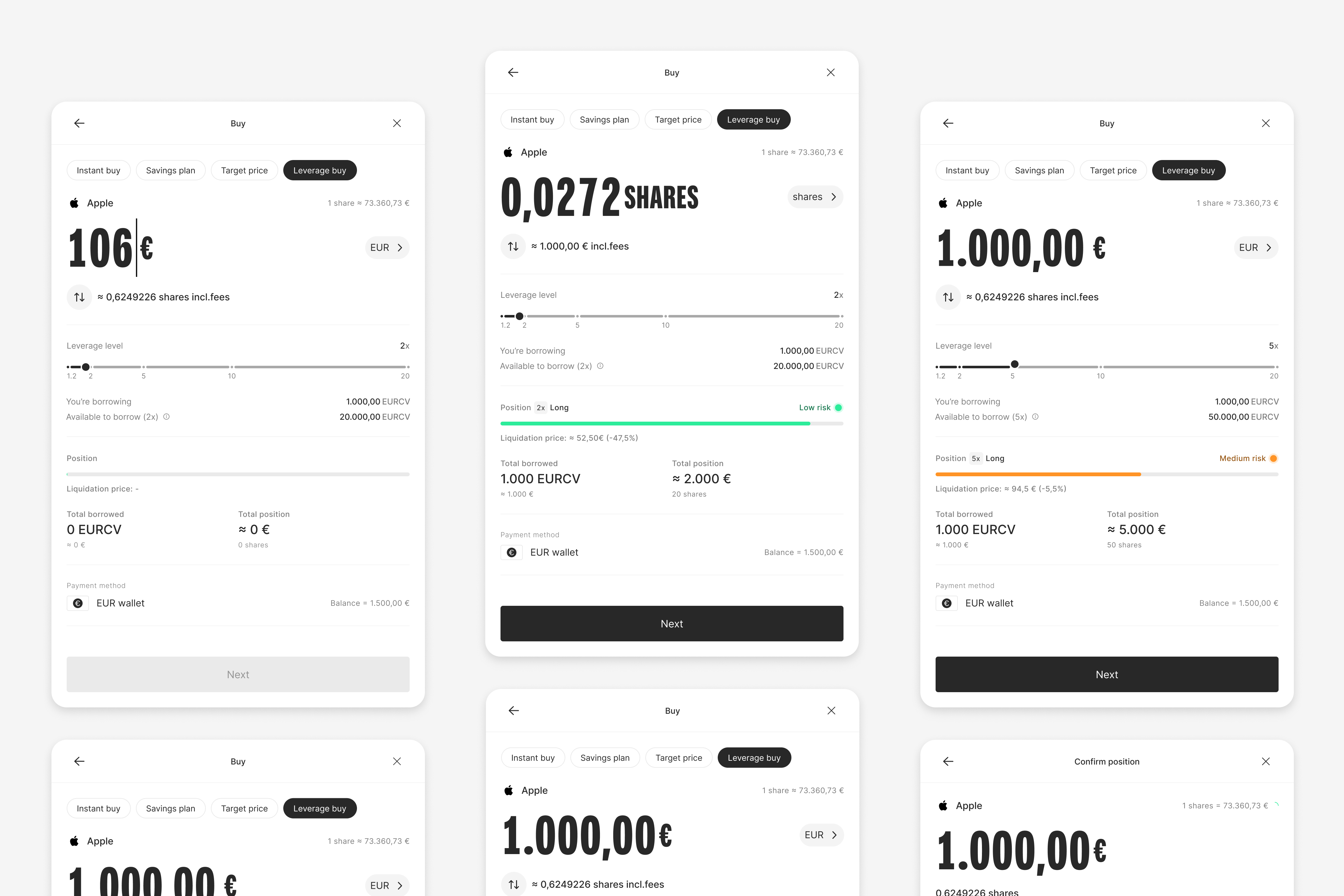
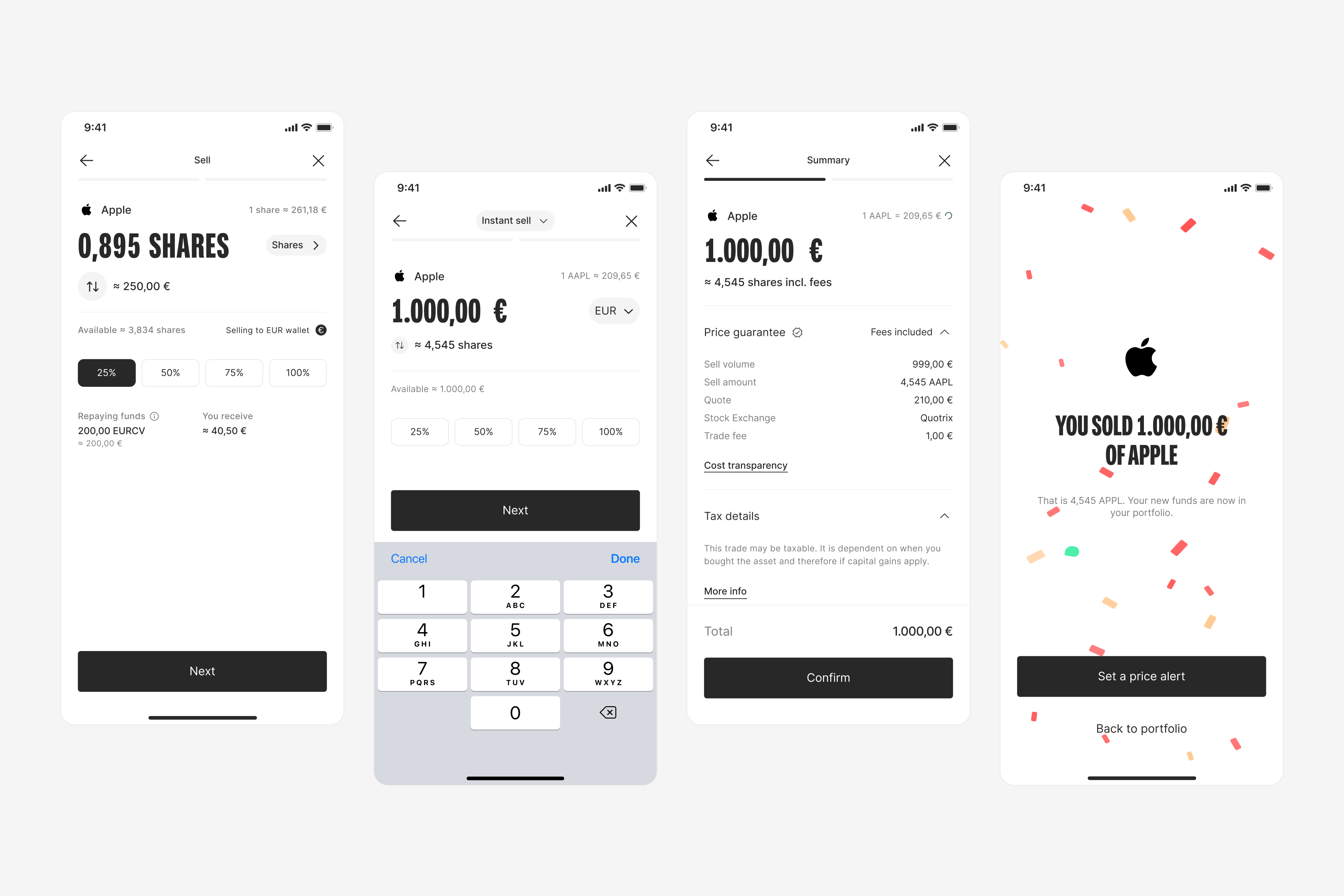
Across the project, we designed and delivered a broad range of product experiences, including margin trading flows for crypto and real stocks on both web and app, the market hours experience showing users when they can and cannot trade real stocks, limit order flows, open position flows, and the portfolio experience. Where mobile designs already existed, we adapted them thoughtfully for web, keeping things consistent across platforms whilst making sure each experience felt right for its context.
A walk-through of four key product experiences across web and mobile:
How we delivered mattered just as much as what we delivered. We worked as team players within Bitpanda's cross-functional setup, staying close to product owners and collaborating directly with engineers, product managers, and project managers throughout.
Handovers were clear and well-structured so engineering could pick up the work without unnecessary back-and-forth, and in refinement sessions we brought the expertise needed to surface gaps early and resolve them before they had a chance to slow things down.
Closing the gap between Design and Engineering
Like any fast-moving product organisation, there were areas where the connection between design and engineering had room to become tighter. By working closely with Bitpanda’s team, we helped their engineering and design teams stay much better aligned through a more structured approach to handovers between teams. Together, we sectioned work clearly and logically so that engineers had everything they needed to move forward, removing ambiguity from the equation.
Through this approach, the result was a cleaner, more efficient handover process that both teams could rely on, reducing unnecessary questions and keeping implementation moving at the pace the project demanded.

In refinement sessions, we took an active role alongside engineers, product managers, and project managers, coming prepared to identify missing requirements, surface design gaps, and resolve ambiguities in the room rather than downstream. By shifting these conversations earlier in the process, issues that might otherwise have emerged mid-sprint were addressed at a point when the cost of resolving them was significantly lower.
The impact was a measurably smoother implementation process for Bitpanda's engineering teams, with less back-and-forth, fewer blockers, and a cleaner path from design intent to built output. For an organisation operating at Bitpanda's pace, that improvement translated directly into more reliable and more confident delivery.
The Deliverables
Over the course of the engagement, our team designed and delivered a broad range of product experiences that sat at the heart of Bitpanda's push into multi-asset trading.
A big part of the work was about giving users the ability to trade real stocks with the same ease they already associated with Bitpanda's crypto offering. That meant building out the full sell flow for real stocks on both web and mobile, designing a savings plan feature so users could set up recurring buys, and creating the target price flow, which is Bitpanda's in-platform name for limit orders, letting users buy or sell at a price they define in advance. The goal throughout was to make these more sophisticated trading behaviours feel as simple and accessible as everything else on the platform.
One of the most impactful areas we supported was the v3 to v4 migration for the margin trading feature. This kind of work is easy to deprioritise when a team is already stretched, yet important enough that letting it slip carries real consequences for product consistency. Every existing user flow needed to be carefully rebuilt to align with Bitpanda's refreshed design language, communicating critical financial concepts clearly and honestly without overwhelming users or losing the simplicity Bitpanda is known for.
Without enough internal capacity to move at pace, the migration risked becoming a bottleneck. Our team helped alleviate the pressure by taking ownership of key flows, including open, add, and close position for crypto margin trading. This gave Bitpanda the capacity to move quickly and consistently through the transition, keeping the product coherent whilst the rest of the team stayed focused on building what was new.
Finally, we also supported smaller but meaningful product improvements, including the ability for users to make small crypto transactions that adds genuine everyday value for users who actively manage their portfolio.
Closing the Engagement
When we began working with Bitpanda, design was largely responding to delivery pressure rather than getting ahead of it. By the close of our engagement, that dynamic had meaningfully shifted. Working closely alongside Bitpanda's team, we supported the establishment of stronger foundations, contributing to components being built to a standard the broader team could pick up and use correctly, and helping to ensure the Design System was documented clearly enough to reduce the reliance on institutional knowledge that had previously made scaling difficult.
The clearest measure of that progress is what happens next. New team members can onboard onto the Design System without requiring hours of walkthrough and training. Designers across the organisation have clearer reference points for how components should be built and used. Finally, the quality of what ships no longer depends on a small group of people who happen to know how everything fits together.


View More Work